Voices of the Future: What Is Coming Up Next? - with JRE-Croatia Member Rudolf Štefan
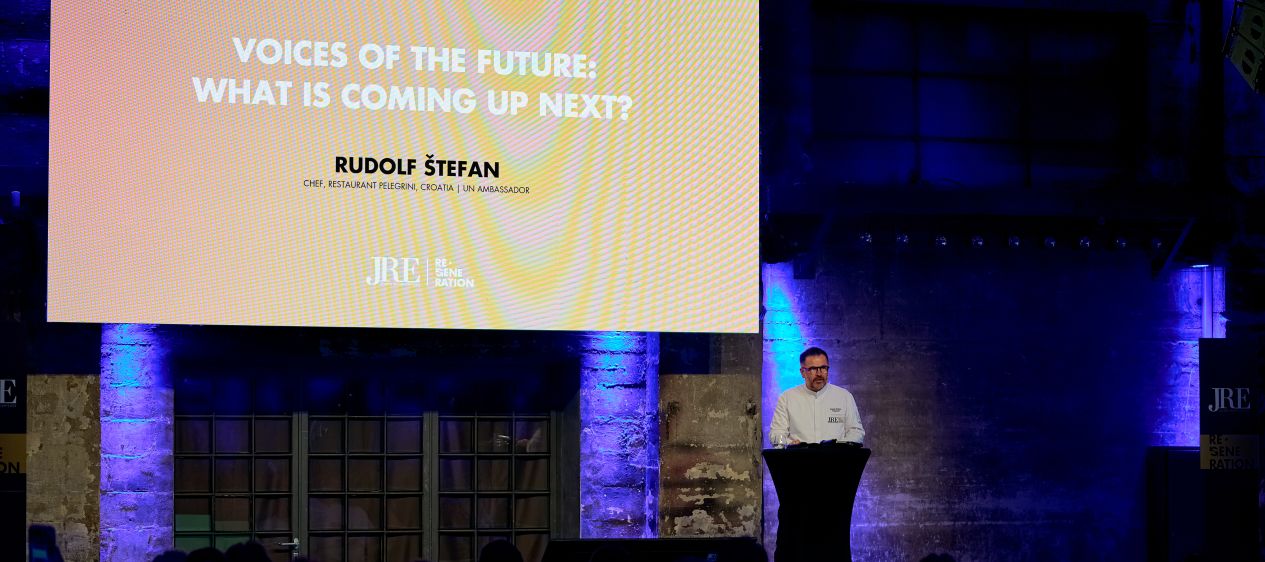
At the JRE Congress on April 20, Rudolf Stefan, chef of Restaurant Pelegrini in Croatia and UN Ambassador, shared a personal reflection on the direction of fine dining. Addressing fellow chefs and restaurateurs, he spoke about the limits of perfection, the importance of emotional connection, and the role of hospitality in a rapidly changing world.
What followed was a clear shift in perspective: from performance to presence, from precision to people.
Rudolf Štefan on Why Perfection Is Not Enough
A few winters ago, in Šibenik, it was cold. One of those sharp Dalmatian nights when the wind enters your bones.
A couple came into Pelegrini. They had dressed beautifully. You could see it was an important evening. Maybe an anniversary. Maybe something unspoken. They sat down close to each other.
Service began.
The first dish arrived. Then the explanation.
Seven minutes.
The second dish. Another explanation.
A Wine pairing: soil composition, fermentation, aging.
When they left, I watched them through the window. They had barely spoken to each other.
The dinner was technically flawless. But something felt wrong.
That night, I realized something uncomfortable: We had executed perfection and stolen their moment.
Perfection is not the goal
I am a chef. I am a restaurateur. I am also a UN ambassador. And in all three roles, I learned one simple truth:
People do not search for perfection. They search for connection.
Yet fine dining has trained us to chase perfection obsessively. Temperature, texture, technique, precision. And somewhere inside that precision, we lost warmth.
When passion becomes performance
Let me tell you what I started noticing.
A business meeting at a corner table. Two partners. A conversation that matters. A waiter approaches with passion, and that passion is beautiful.
But sometimes passion becomes performance. Every ingredient explained. Every micro herb justified. Every technique defended.
And I watch the guests. They are polite. They smile. But their eyes are waiting, waiting for the monologue to end.
We speak about “guest experience.” But sometimes we interrupt the experience with ourselves.
Luxury is space
Luxury today is not more information. Luxury is space.
Presentation should be subtle. Gentle. Elegant. Give the key details. Offer the story. But leave room for silence.
If the guest wants more, we must be ready. But we must learn to feel the table. Because every guest is different.
Some guests want science.
Some guests want emotion.
Some want conversation.
Some want quiet.
Our job is not to show how much we know. Our job is to understand how much they need.
Emotional harmony
There is another detail we often ignore: Emotion has temperature.
If it is winter outside, and a guest walks in from the cold, their body is asking for warmth. If we welcome them formally, distantly, if we serve a cold amuse-bouche, a cold soup, an ice-cold sparkling wine, even if everything tastes brilliant, the emotional memory becomes cold.
Hospitality is not only about flavor harmony. It is about emotional harmony.
A wider perspective
As a UN ambassador, I visit places where food is fragile. Where sharing bread is an act of dignity.
In those places, nobody speaks about technique. They speak about generosity. They speak about welcome. They speak about humanity.
And I return to our world, our beautiful, ambitious, creative world, and I ask myself: When did we start designing restaurants that impress more than they embrace?
Adapting to what is next
The world is changing faster than our concepts. Guests travel more. They compare more. They question more.
If we redesign our restaurant once a year, we are already late. We must listen daily, to the market, to society, to our teams, and to subtle shifts in expectation.
Adaptation is not weakness. It is survival.
The role of JRE
And this is where I see us. This is where I see the power of JRE.
We are not a corporate chain. We are not a collection of cold, standardized luxury.
We are owners. We are creators. We are the faces behind the doors.
In a world that is becoming more digital, more distant, and more perfectly boring, we have the one thing that cannot be automated: a soul. Our restaurants are not just businesses. They are our homes, and that is our greatest advantage.
But we must be brave. We must have the courage to be imperfectly human. We must be the ones who lead the change. The ones who say: "Yes, my technique is world-class, but my hospitality is world-changing."
JRE should not only be a symbol of great food. It should be a global symbol of great hosting. A place where a guest walks in and thinks: Finally. Someone who sees me. Someone who is not trying to lecture me, but trying to nourish me.
What guests will remember
I often think back to that couple in Šibenik. I don’t know their names. But I remember their silence. And I promised myself that night: Never let my ego or my techniques stand in the way of their moment.
My dear colleagues, my JRE family, The future is not found in a laboratory or a new machine. It is found in the warmth of our welcome. In the sincerity of our stories. In the speed with which we listen to our guests every single day.
Let’s not just be the best chefs in the world. Let’s be the best hosts the world has ever seen. Because in the end, no one will remember the exact acidity of your sauce. But they will always remember how they felt at your table.
And that is the only star that truly matters.
A shared direction for JRE
Štefan's message reinforces a shift that is becoming increasingly clear across the industry. Technical excellence alone is no longer enough.
What defines the future of gastronomy is the ability to create connection, to read the room, and to respond with authenticity.
For JRE, this means embracing what makes independent restaurants unique: personality, presence, and a sense of place. In a world that is becoming more standardized, this human element is not a weakness, it is the greatest strength.